
Uncategorized
What Is Epitalon? Research Background and Study Areas
Sep
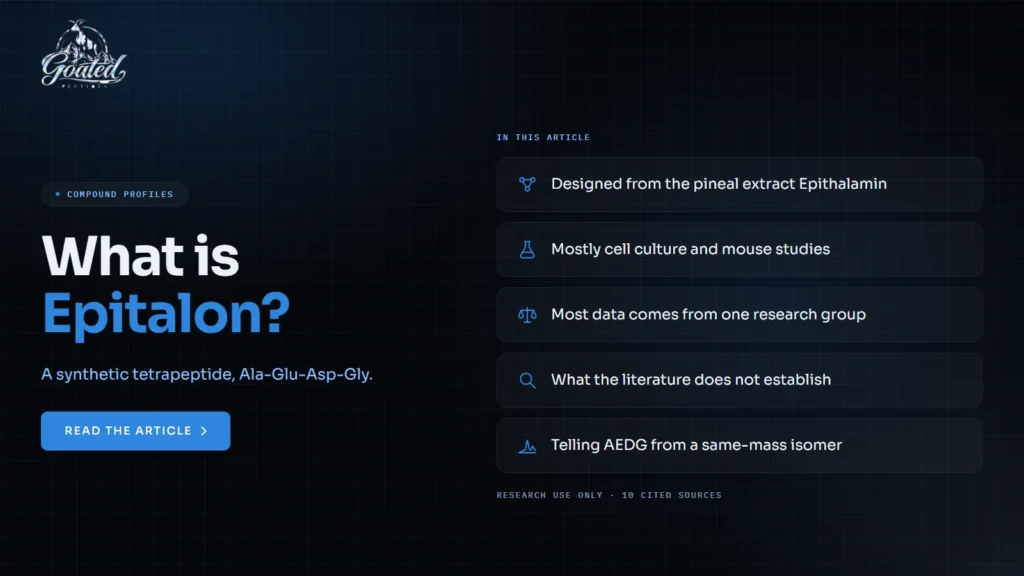
Epitalon is a synthetic tetrapeptide with the sequence Ala-Glu-Asp-Gly, also written AEDG or Epithalon. It was designed from the amino acid composition of Epithalamin, a polypeptide extract of bovine pineal gland, by researchers in St. Petersburg, Russia.
Its published record is mostly cell culture and animal work, and most of it comes from one research group, so what was measured matters more than what has been claimed.
This profile sets out what the Epitalon peptide is chemically, which study types make up its literature, and where that literature stops. It closes with how a lot is identified analytically, which connects to how a lot is analyzed before it is listed.
It belongs to the Journal’s compound profile series, alongside the MOTS-c research profile and the GHK-Cu research profile.
The article covers laboratory research only and contains no preparation or dosing information.
What the Epitalon peptide is chemically
Epitalon is a linear chain of four L-amino acids: alanine, glutamic acid, aspartic acid and glycine, in that order. PubChem lists its molecular formula as C14H22N4O9 and its molecular weight as 390.35, with Epithalon and Epithalone among its recorded synonyms.
The peptide came out of earlier work on Epithalamin. A 2025 review in the International Journal of Molecular Sciences describes Epitalon as synthesized on the basis of Epithalamin’s amino acid composition, and states that early research on the extract was led mainly by V. K. Khavinson and V. N. Anisimov. The sequence was designed first and looked for in tissue later. In a 2017 analytical study, Khavinson’s group reported detecting AEDG by mass spectrometry among the tetrapeptides of a pineal polypeptide complex.
Epithalamin, the extract
A polypeptide preparation from bovine pineal gland. It is a mixture of free amino acids and short peptides rather than one defined molecule.
Epitalon, the tetrapeptide
One defined sequence, Ala-Glu-Asp-Gly, made by chemical synthesis. Because it is a single structure, it can be identified and characterized lot by lot.
Telomerase and ALT
Telomerase is the enzyme that adds repeat sequences to chromosome ends. Alternative lengthening of telomeres, or ALT, is a telomerase-independent route found in some cancer cell lines.
Older papers report on either the extract or the peptide, and results for one cannot be read as results for the other without qualification.
What published research on Epitalon examines
Most published Epitalon work falls into three groups: cell culture studies of telomere biology, cell culture studies of gene expression, and animal studies. The 2025 review counts in vitro, in vivo and in silico work across roughly 25 years.
- Telomerase in fetal fibroblasts, in vitro. A 2003 cell culture study added Epitalon to telomerase-negative human fetal fibroblasts and reported expression of the telomerase catalytic subunit, telomerase enzymatic activity and telomere elongation.
- Passage number in fibroblast culture, in vitro. A 2004 follow-up used fetal lung fibroblasts that stopped dividing at passage 34 in control culture. Peptide-exposed cultures showed telomere lengths comparable to early passages and were still dividing at passage 44.
- Neurogenic markers in stem cells, in vitro and in silico. A 2020 study in human gingival mesenchymal stem cells measured Nestin, GAP43, beta III tubulin and Doublecortin at the protein and mRNA level and reported higher expression. Molecular modeling proposed binding sites on histones H1/3 and H1/6. The authors present the epigenetic mechanism as possible, not demonstrated.
- Biomarkers in mice, animal model. A 2003 study in female SHR mice followed 54 animals per group and measured body weight, estrous function, chromosome aberrations in bone marrow cells, spontaneous tumor incidence and survival. The authors reported no difference in body weight or mean survival, and differences in some secondary measures, including estrous function and chromosome aberration frequency.
- Telomere length in four human cell lines, in vitro. A 2025 study from Brunel University London measured telomere length by qPCR, hTERT expression, telomerase activity by TRAP assay, and ALT markers. In normal epithelial cells and fibroblasts the authors reported telomere lengthening with telomerase upregulation. In two breast cancer cell lines they reported lengthening associated with ALT activity.
None of these designs measures an outcome in a person. Each measures an enzyme, a marker, a passage count or an animal endpoint in one defined model.
How strong the evidence base for Epitalon is
It is narrow. Most of the record traces to one St. Petersburg research network centered on V. K. Khavinson and V. N. Anisimov. The St. Petersburg Institute of Bioregulation and Gerontology appears in the affiliations of the telomerase, pineal complex and stem cell papers above, and Khavinson is an author on every primary study in the previous section except the Brunel paper.
Independent replication is limited. The Brunel group, which shares no authors with the St. Petersburg papers, wrote that its results in normal cells agreed with the earlier telomerase findings. The same authors also wrote that very little quantitative data had been published comparing telomere length, hTERT expression, telomerase and ALT activity in exposed cells. Their own work was a 2D cell culture study, a limit they state themselves.
When one group produces most of a literature, its methods, reagents and assumptions repeat across papers. Agreement between those papers is not the same as confirmation. A finding carries more weight once a separate laboratory, working with its own material, reproduces it.
In practice, effect sizes in the early papers are single-laboratory estimates, and proposed mechanisms such as histone binding rest on modeling and one group’s assays. Reviews, including the 2025 overview, draw heavily on the same primary sources, so a count of reviews is not a count of independent studies.
What the Epitalon literature does not establish
The gaps are wider than the findings.
- Independent human data. The 2025 review describes a clinical trial run at the St. Petersburg Institute of Bioregulation and Gerontology. We did not find human data from an unaffiliated group.
- Organism-level effects from cell work. Telomerase activity or telomere length in a culture dish does not establish any effect in a whole animal or a person. The Brunel authors call for 3D culture and animal models as the next step.
- Generality of the mouse findings. The mouse work used one strain and one sex, came from one research network, and showed no difference in body weight or mean survival. It cannot be extended to other species.
- A settled mechanism. The 2025 review concludes that the mechanism of action remains unclear, and that physico-chemical and structural studies of the peptide are very limited.
- The meaning of the cancer cell result. The Brunel group described telomere lengthening through ALT in breast cancer cell lines as unexpected. Its significance has not been established.
- A federal safety finding. On its page of bulk drug substances that may present significant safety risks, FDA states that it has not identified safety-related information on epitalon for the proposed route and lacks sufficient information to know whether it would cause harm in humans. FDA also notes a potential for aggregation and peptide-related impurities.
Reading a certificate for an Epitalon lot
Research material is only as interpretable as its identity. For a short peptide, identity rests on mass and on sequence, and those are two different tests.
Mass spectrometry confirms that a molecule of the expected mass is present. On its own it cannot tell AEDG from a peptide with the same four residues in another order. In a 2015 analytical study, researchers used liquid chromatography with tandem mass spectrometry to identify Epitalon in two preparations labeled as containing it, and considered confusion with the isomer Glu-Ala-Asp-Gly. They separated the two by heating the sample, which converts an N-terminal glutamic acid to pyroglutamate and lowers its mass.
- Lot number on the certificate matches the lot number on the vial label
- Compound named as Epitalon with the full sequence Ala-Glu-Asp-Gly stated
- Molecular formula C14H22N4O9 and expected mass stated
- Identity confirmed by mass spectrometry with the observed mass reported
- Method able to distinguish sequence isomers, such as tandem mass spectrometry
- Chromatographic purity reported as a result for that lot
- Testing laboratory, test date and analyst sign-off recorded
A certificate describes one lot. It says nothing about another lot, and nothing about what the peptide does in any model. The research use only policy and the compliance overview set out the terms that apply to this material, and the frequently asked questions page covers documentation queries.
Goated Peptides publishes its lot records in the lot-matched certificate library. To check the points above against a real document, look up an Epitalon lot there and compare its lot number, sequence and mass spectrometry result with the vial label.
- Epitalon is the synthetic tetrapeptide Ala-Glu-Asp-Gly, designed from the pineal extract Epithalamin
- Its literature is in vitro, animal and in silico work on telomere biology and gene expression
- Most studies come from one St. Petersburg research network, and independent replication is limited
- No published work establishes an effect in people
- Lot identity needs both mass and sequence confirmation, tied to one lot number
Frequently asked questions
Epitalon is a synthetic tetrapeptide with the sequence Ala-Glu-Asp-Gly, abbreviated AEDG and also spelled Epithalon. Its molecular formula is C14H22N4O9 and its molecular weight is 390.35. It was designed in St. Petersburg from the amino acid composition of Epithalamin, a bovine pineal extract, and is studied as a research compound in cell culture and animal models.
No. Epithalamin is a polypeptide extract of bovine pineal gland, a mixture of free amino acids and short peptides. Epitalon is one defined tetrapeptide synthesized from that extract’s amino acid composition. The same group later reported detecting AEDG within a pineal polypeptide complex, which links the two, but results for the extract cannot be read as results for the synthetic peptide.
Published work covers in vitro telomere studies in human fibroblasts, epithelial cells and cancer cell lines, gene expression studies in human stem cells, and animal studies in mice. Measured endpoints include telomerase activity, telomere length, hTERT expression, ALT markers, neurogenic marker expression and, in mice, measures such as estrous function and chromosome aberrations. None of these establishes an effect in people.
Limited. Most of the literature comes from one research network in St. Petersburg around V. K. Khavinson and V. N. Anisimov. Independent replication is sparse, and a 2025 in vitro study from Brunel University London is one of the few unaffiliated datasets. Findings are best read as single-laboratory results in specific models, not as established properties of the peptide.
By confirming both mass and sequence. Mass spectrometry shows that a molecule of the expected mass, about 390 daltons, is present, but a same-mass isomer such as Glu-Ala-Asp-Gly gives the same parent mass. Tandem mass spectrometry or another sequence-sensitive method resolves this. The certificate should tie those results to a single lot number that matches the vial label.
- Epitalon, compound summary (CID 219042). PubChem, National Center for Biotechnology Information. View source
- Araj SK, Brzezik J, Madra-Gackowska K, Szeleszczuk L, 2025. Overview of Epitalon, Highly Bioactive Pineal Tetrapeptide with Promising Properties. International Journal of Molecular Sciences, 26(6), 2691. DOI
- Khavinson VK, Kopylov AT, Vaskovsky BV, Ryzhak GA, Lin’kova NS, 2017. Identification of Peptide AEDG in the Polypeptide Complex of the Pineal Gland. Bulletin of Experimental Biology and Medicine, 164, 41 to 43. DOI
- Khavinson VKh, Bondarev IE, Butyugov AA, 2003. Epithalon peptide induces telomerase activity and telomere elongation in human somatic cells. Bulletin of Experimental Biology and Medicine, 135, 590 to 592. DOI
- Khavinson VKh, Bondarev IE, Butyugov AA, Smirnova TD, 2004. Peptide promotes overcoming of the division limit in human somatic cell. Bulletin of Experimental Biology and Medicine, 137, 503 to 506. DOI
- Khavinson V, Diomede F, Mironova E, Linkova N, Trofimova S, Trubiani O, Caputi S, Sinjari B, 2020. AEDG Peptide (Epitalon) Stimulates Gene Expression and Protein Synthesis during Neurogenesis: Possible Epigenetic Mechanism. Molecules, 25(3), 609. DOI
- Anisimov VN, Khavinson VKh, Popovich IG, Zabezhinski MA, Alimova IN, Rosenfeld SV, Zavarzina NY, Semenchenko AV, Yashin AI, 2003. Effect of Epitalon on biomarkers of aging, life span and spontaneous tumor incidence in female Swiss-derived SHR mice. Biogerontology, 4, 193 to 202. DOI
- Al-dulaimi S, Thomas R, Matta S, Roberts T, 2025. Epitalon increases telomere length in human cell lines through telomerase upregulation or ALT activity. Biogerontology, 26(5), 178. DOI
- Certain Bulk Drug Substances for Use in Compounding that May Present Significant Safety Risks. FDA, April 2026. View source
- Vanhee C, Moens G, Van Hoeck E, Deconinck E, De Beer JO, 2015. Identification of the small research tetra peptide Epitalon, assumed to be a potential treatment for cancer, old age and Retinitis Pigmentosa in two illegal pharmaceutical preparations. Drug Testing and Analysis, 7, 259 to 264. DOI
- September 21, 2026: First published.
This article is general educational information about published laboratory research. It is not medical, legal or regulatory advice, and nothing in it describes or recommends the use of any compound in people or animals. Compounds discussed are for Research Use Only: not for human or veterinary use, not for diagnostic use, and not for use as a food, dietary supplement or cosmetic. The Goated Peptides Journal is published by Goated Peptides LLC, which supplies research materials, including compounds discussed on this site. Links to certificates and policies are provided for lot documentation and policy reference.
