
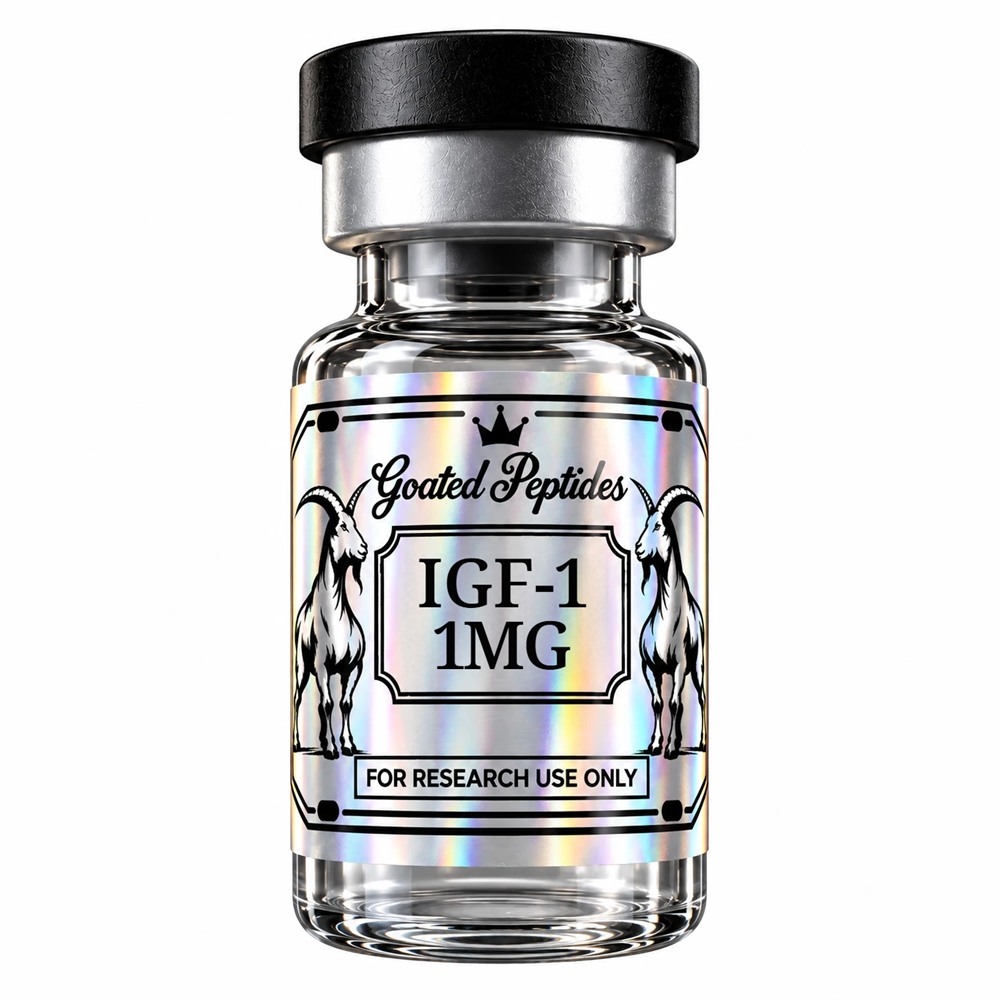
IGF-1
$69.00
IGF-1 supplied as a lyophilised, sealed vial with the batch certificate of analysis linked below.
Research Use Only. Not for human or veterinary use.
Overview
IGF-1 is insulin like growth factor 1, a 70 amino acid single chain polypeptide with three disulfide bridges and substantial structural homology to proinsulin. It sits at the centre of the somatotropic axis and is one of the most studied growth factors in cell biology. Research grade IGF-1 is catalogued in several forms, including the native sequence and the LR3 and DES analogues, which differ meaningfully in receptor binding and in their affinity for the IGF binding proteins. The form and content for the lot supplied are stated on its Certificate of Analysis, and researchers should confirm which variant they are holding before designing around published figures, because results do not transfer cleanly between them.
Areas of research interest
The points below describe where this material, or the compound class it belongs to, appears in the published scientific literature. They are provided to help researchers scope a study design. They are not claims about what this product does and no outcome of any kind is represented.
- IGF-1 receptor binding and downstream PI3K and Akt signalling assays
- Cell proliferation and differentiation models in culture
- IGF binding protein interaction and displacement studies
- Comparative work across native IGF-1 and its LR3 and DES analogues
Specifications
| Catalogue name | IGF-1 |
|---|---|
| Vial content | 1 mg |
| Physical form | Lyophilised powder |
| Appearance | White to off-white lyophilised cake |
| Diluent / solubility | Bacteriostatic water or sterile water. Confirm working solubility against your own protocol. |
| Purity | Lot specific. Stated on the Certificate of Analysis issued for the lot supplied. |
| Storage | -20 °C sealed, protected from light. 2 to 8 °C after reconstitution. |
| Classification | Research Use Only (RUO). Not for human or veterinary use. |
Handling, reconstitution and storage
- Store sealed vials at -20 °C, protected from light. Short excursions to 2 to 8 °C in transit are expected; return vials to frozen storage on receipt.
- Reconstitute with bacteriostatic water or another diluent appropriate to your protocol. Add the diluent slowly against the inner wall of the vial and allow the cake to dissolve without agitation. Do not shake.
- After reconstitution, store at 2 to 8 °C and protect from light. Establish an in-use period from your own stability testing rather than from a supplier figure.
- Avoid repeated freeze-thaw cycles. Aliquot where a protocol calls for multiple withdrawals from a single vial.
- Use aseptic technique and standard personal protective equipment throughout. Allow vials to reach room temperature before opening to limit condensation.
Certificate of Analysis
Every lot is supplied with its own Certificate of Analysis. Identity, content and purity figures are those stated on that document for the specific lot supplied, and researchers should verify identity and suitability against their own analytical methods before the material is put into a study.
Research use only
This product is supplied strictly for laboratory research use only. It is not a drug, food, cosmetic or dietary supplement. It is not intended to diagnose, treat, cure or prevent any disease, and it is not intended for human or veterinary consumption or for administration to humans or animals in any form. It must be handled only by qualified researchers in an appropriate laboratory setting, and it is the purchaser who is responsible for ensuring that their intended use complies with all laws and institutional requirements that apply to them.
| Size | 1mg |
|---|
Be the first to review “IGF-1”
Related products
Peptides
Peptides
Peptides
Peptides
Peptides
Peptides
Peptides
Peptides
Reviews
There are no reviews yet.